Journal of Civil Engineering and Environmental Sciences
Review and Suitability of the Conception of Architectural Design for the Structural Design of Building Covers
Universidad Privada del Norte, Faculty of, Trujillo, Perú
Author and article information
Cite this as
Aguilar Zavaleta JP. Review and Suitability of the Conception of Architectural Design for the Structural Design of Building Covers. J Civil Eng Environ Sci. 2026; 12(2): 14-20. Available from: 10.17352/jcees.000100
Copyright License
© 2026 Aguilar Zavaleta JP. This is an open-access article distributed under the terms of the Creative Commons Attribution License, which permits unrestricted use, distribution, and reproduction in any medium, provided the original author and source are credited.Background: Architectural and structural design are frequently managed as sequential specialties, even though decisions on geometry, spatial organization, materiality and structural systems are strongly coupled from the earliest project stages.
Objective: This article reviews the suitability of architectural design conception for structural design and proposes an integrated framework for decision-making that connects architectural intent, structural performance, sustainability, and digital information management.
Methods: A qualitative documentary analysis was conducted on the supplied manuscript, recent peer-reviewed literature on BIM, multidisciplinary design optimization, generative design, digital twins, and life-cycle assessment, and current technical and normative sources, including ISO 19650, the second-generation Eurocodes, and the Peruvian regulatory and BIM framework. The material was analyzed thematically and categorically across four axes: design integration, structural performance, sustainability, and digital interoperability.
Results: The synthesis identifies seven recurring integration requirements: early structural participation, explicit load-path reasoning, shared information structures, performance-based iteration, life-cycle environmental assessment, constructability feedback, and human validation of computational outputs. BIM is most useful when treated as an information-management methodology rather than a visualization tool; generative AI and optimization add value mainly as design-space exploration mechanisms subject to code-based and engineering verification.
Conclusions: Architectural suitability for structural design should be evaluated as a coupled performance problem rather than as a late technical adjustment. The proposed workflow provides a practical framework for multidisciplinary design and supports application in Peru, where BIM adoption and the E.030 seismic regulation are being updated in 2025–2026.
Architectural conception is not independent of structural behavior. The definition of spans, grids, openings, cantilevers, vertical irregularities, floor-to-floor heights, envelope systems and circulation cores constrains the available structural alternatives before a formal structural model is developed. Conversely, the structural system feeds back into architectural decisions through member dimensions, stiffness distribution, construction sequence, vibration control, material use and durability. The central problem is therefore not whether architecture should be adapted to structure, but how architectural and structural decisions can be coordinated early enough to prevent costly redesign and performance conflicts.
The supplied manuscript already recognizes four essential components of this relationship: functionality and aesthetics, sustainability, interdisciplinary collaboration, and technological integration. It also identifies BIM, simulation, artificial intelligence, virtual reality, and digital fabrication as emerging mechanisms for improving coordination. However, its original discussion is predominantly descriptive and its references rely heavily on generic websites and non-peer-reviewed sources. A higher-rigor version requires a clearer research question, an explicit documentary method, a distinction between architectural intent and structural performance, and a stronger connection to current standards and research on BIM interoperability, multidisciplinary optimization, and computational design [1-3].
Recent literature shows that the research frontier has moved from isolated digital tools toward integrated decision environments. A review of BIM and structural design identified interoperability, automation, and the integration of structural analysis as persistent research issues, while a broader review of multidisciplinary design optimization (MDO) found that structural, energy, daylighting, and other performance domains remain frequently compartmentalized. These findings are important because architectural suitability cannot be judged using aesthetics or code compliance alone; it must be assessed across interacting technical and life-cycle criteria.
The digital transition reinforces this need. ISO 19650 defines BIM as an information-management framework that supports the exchange, recording, versioning, and organization of information across the life cycle of an asset. In Peru, the Plan BIM Perú explicitly adapts ISO 19650 principles to public investment and defines BIM as a collaborative methodology for information management rather than merely a software category. The Peruvian BIM framework has also advanced toward mandatory application in selected public-investment typologies, reinforcing the relevance of integrated architectural–structural workflows [4,5,].
The regulatory context is equally relevant. The Ministry of Housing, Construction and Sanitation modified the Peruvian E.030 seismic design standard in April 2026 and subsequently amended the transitional provision in June 2026. The current regulatory trajectory increases the importance of early coordination between architectural configuration and seismic structural response, particularly for irregularity, mass distribution, stiffness, ductility, and load-path continuity [6,7].
Against this background, the research question is: how can architectural design conception be evaluated and structured so that it remains compatible with structural safety, constructability, sustainability, and digital information requirements from early design through construction? The objective is to review the architectural–structural relationship, identify the principal compatibility criteria, and formulate an integrated workflow that can be operationalized in BIM-based practice.
Research gap
The documentary evidence suggests three unresolved gaps. First, architecture–structure integration is still frequently organized around sequential handoffs rather than concurrent decision-making. Second, BIM interoperability between authoring and structural-analysis environments remains incomplete, meaning that a federated model does not automatically guarantee semantic consistency or analytical validity. Third, generative and AI-assisted design can expand the design space, but their outputs still require explicit code, constructability, and engineering validation. Recent reviews of generative AI and generative design emphasize both the potential for optimization and the lack of standardized evaluation and real-world regulatory integration.
Methods
Research design
A qualitative documentary analysis was adopted because the purpose of the study is conceptual and integrative rather than experimental. The unit of analysis was the proposition concerning the relationship among architectural conception, structural design, digital information, and building performance. The procedure was organized in four stages: (1) source identification and screening; (2) thematic and categorical coding; (3) triangulation across scientific, normative and institutional sources; and (4) synthesis into an integrated decision framework. This approach follows established review practice in BIM and life-cycle research while remaining transparent that the present article is not a systematic review registered under PRISMA.
Source strategy
Three source groups were considered. Group A comprised peer-reviewed research published mainly from 2021 to 2025 on architectural–structural integration, BIM interoperability, multidisciplinary optimization, generative design, digital twins, life-cycle assessment and design automation. Group B comprised international technical standards and regulatory frameworks, including ISO 19650 and the second-generation Eurocodes. Group C comprised official Peruvian sources, principally the Reglamento Nacional de Edificaciones (RNE), the 2026 E.030 update, and the Plan BIM Perú. The original manuscript was retained as the conceptual starting point, but references without identifiable scholarly or institutional provenance were not used as evidence for key claims.
Inclusion and exclusion criteria (Table 1)
Analytical categories
The evidence was coded into four principal categories: C1, architectural–structural integration; C2, structural performance and resilience; C3, sustainability and life-cycle performance; and C4, digital interoperability and computational augmentation. Within each category, recurrent variables, benefits, barriers and validation requirements were identified. The final synthesis did not treat software output as evidence of structural adequacy; rather, computational tools were classified as means for generating, coordinating or testing design alternatives.
Reliability and limitations of the method
Reliability was improved through triangulation: claims concerning structural design were checked against engineering literature; claims concerning BIM were checked against standards and implementation frameworks; and claims concerning Peruvian practice were checked against official governmental sources. No primary interviews, laboratory tests, or structural numerical experiments were conducted in this study. Therefore, the results represent a documentary synthesis and a methodological framework, not an empirical validation of a specific building.
Results
Evolution of the architectural–structural relationship
The reviewed evidence shows an evolution from disciplinary separation toward increasingly integrated design environments. The traditional sequence—architectural concept, structural adaptation, documentation and construction—remains useful as an organizational model but becomes inefficient when geometry and structural behavior are strongly coupled. BIM, performance simulation and optimization make earlier feedback technically feasible, reducing the need to postpone structural decisions until the design is substantially fixed. The literature on BIM and structural projects specifically identifies automation, interoperability, and structural-analysis integration as central research themes.
The shift can be characterized in four stages: representation, coordination, performance integration and optimization. Representation digitizes architectural and structural objects; coordination detects geometric or information conflicts; performance integration links the model to analysis and simulation; and optimization uses multiple alternatives to search for better compromises among structural, environmental, economic and architectural objectives. The literature increasingly treats the last two stages as coupled rather than independent (Table 2).
Architectural criteria that condition structural suitability
The architectural concept becomes structurally suitable when its principal decisions can be translated into a coherent structural system without relying on late corrective measures that undermine the original spatial or formal intent. Six criteria recur across the evidence: continuity of the load path; geometric regularity or consciously managed irregularity; compatible spans and structural depth; alignment between vertical systems; feasible construction and connection logic; and compatibility with environmental and life-cycle objectives. Structural adequacy therefore begins before sizing beams and columns.
For seismic regions, the interaction is especially direct. The Peruvian E.030 framework makes the structural response of a building dependent on characteristics that architecture often defines—distribution of mass and stiffness, configuration, diaphragm action, discontinuities and vertical or plan irregularities. The 2026 update of E.030 confirms the continued regulatory emphasis on seismic safety and modernized requirements [6].
Structural criteria that should feed back into architectural conception
The structural discipline contributes more than a final verification. Early structural input can influence module dimensions, façade rhythm, core placement, floor depth, roof geometry, column-free spaces, transfer strategies, and material selection. Performance-based structural design research also demonstrates that structural decisions can be optimized against multiple objectives, although computational cost and model fidelity remain significant constraints [8].
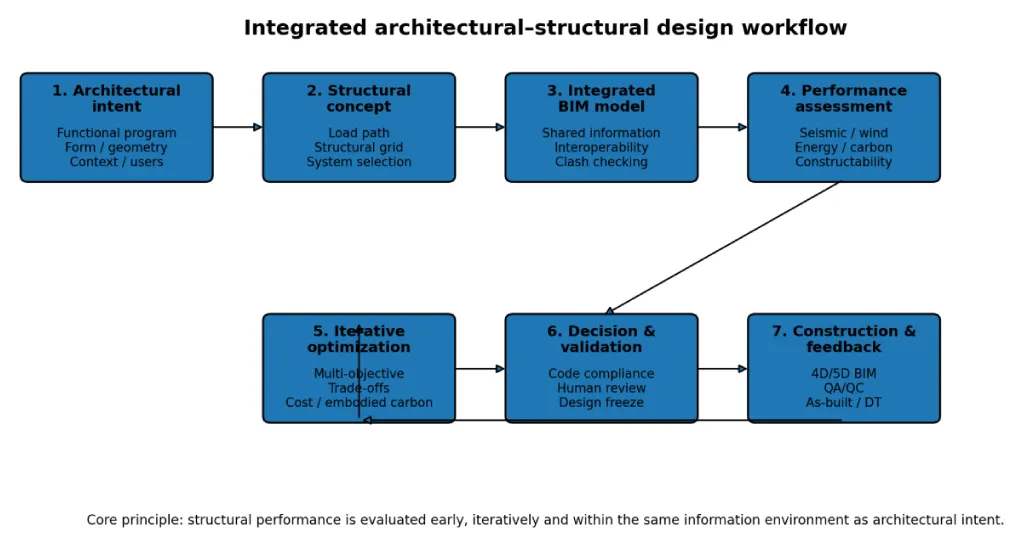
This feedback relationship suggests a principle of reciprocal constraint: architecture defines a feasible structural design space, while structural performance narrows and reshapes that space. The result should not be a compromise in which one discipline dominates, but an iterated solution satisfying minimum safety constraints while maximizing functional, spatial, economic, and environmental value.
BIM as information infrastructure, not only visualization
The review confirms that BIM is most valuable when the model functions as a shared information environment. ISO 19650 establishes principles for information management, including exchange, versioning, organization, and delivery across the asset life cycle. In this sense, BIM supports architecture–structure integration because the model can retain relationships between objects, requirements and decisions rather than only graphical geometry [4].
However, interoperability remains a critical limitation. Studies of structural BIM workflows document losses or mismatches when models are transferred among authoring, analysis and detailing environments. Consequently, a federated model should not be equated with a validated analytical model. Information exchange must be governed by explicit requirements, responsibility matrices, naming conventions, model-checking rules, and verification procedures [1,2,] (Figure 1).
Generative design and artificial intelligence
Generative design and AI extend the ability to explore alternatives but do not replace engineering judgment. Recent reviews show applications in structural generation, topology optimization, performance assessment and architecture, while also identifying limitations related to data quality, interoperability, evaluation standards and scalability. The most defensible role for AI in the present framework is therefore human-in-the-loop exploration: algorithms generate or rank alternatives; architects and engineers define constraints, interpret trade-offs, and validate the selected solution [9-11] (Table 3).
Sustainability and life-cycle implications
The structural system is a major determinant of material use and embodied impacts. A recent review of early-stage strategies for reducing embodied carbon concludes that structural decisions can provide significant mitigation opportunities, but that strategies interact and can involve trade-offs. This reinforces the need to consider carbon, cost, and structural performance during concept development rather than after the structural system has been fixed [12].
BIM-based life-cycle sustainability assessment is progressing but remains incomplete. A systematic review of 135 publications identified continuing difficulties in integrating environmental, economic, and social dimensions into a common BIM-enabled workflow. Thus, the architectural–structural framework should treat sustainability as a concurrent design objective, not a post-design certification exercise [13].
Proposed suitability assessment matrix
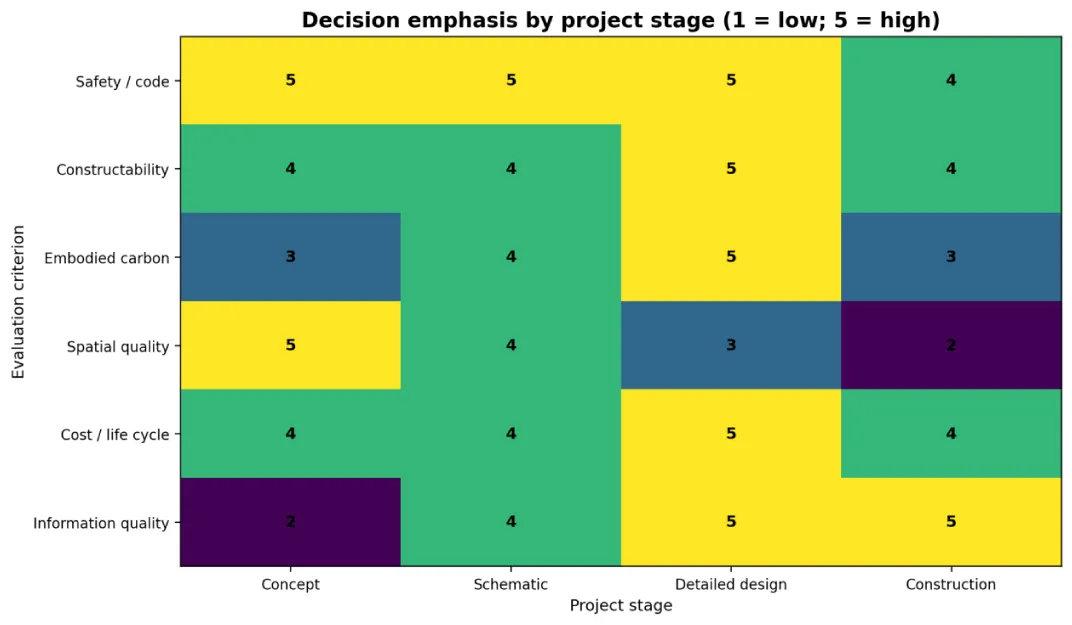
Based on the synthesis, suitability can be evaluated through six decision criteria and four project stages. The objective is not to reduce design to a numerical score, but to force explicit review of the criteria most likely to produce rework or performance conflicts when addressed late (Figure 2).
Discussion
Theoretical implications
The main theoretical implication is that architectural–structural compatibility should be treated as a coupled design-system problem. The reviewed literature on MDO explicitly identifies the fragmentation of structural, energy, and other performance domains as a barrier to unified design. The present synthesis extends that observation by positioning architectural intent itself as an input variable rather than as a fixed boundary condition.
This reframing changes the meaning of “suitability.” A suitable architectural concept is not simply one that can be made to stand. It is one in which the chosen geometry, organization and material logic produce a viable structural search space with acceptable safety, serviceability, constructability and life-cycle performance. This approach is compatible with performance-based design and with multidisciplinary optimization, while retaining the professional and cultural role of architectural judgment.
Practical implications for practice
For practice, the most important implication is temporal: structural participation must begin at concept stage. The minimum integrated workflow should include an architectural massing model, a preliminary structural system, an explicit load-path diagram, early performance checks, a shared information protocol, and at least one documented iteration before design freeze. The process should also define which decisions are reversible, which require specialist sign-off, and which are constrained by regulation.
In Peru, this approach is particularly relevant because Plan BIM Perú is moving toward standardized information requirements and BIM application in public investment, while E.030 was updated in 2026. Together, these changes create an institutional environment in which architectural–structural coordination can increasingly be encoded through information requirements and model-based review rather than relying only on drawing-based coordination. [5,6].
Implications for BIM management and ISO 19650
The integrated workflow should be implemented through explicit information requirements. At project initiation, the appointing party and lead delivery team should define information needs, exchange formats, model federation rules, approval gates and responsibilities. For architecture–structure coordination, this means specifying what geometry, parameters and analytical attributes must be exchanged, at what stage, and which source model governs each decision. ISO 19650 provides the conceptual basis for such information governance across the asset life cycle [4].
Implications for education and professional formation
The original manuscript appropriately emphasizes interdisciplinary collaboration, but the updated evidence suggests a stronger educational implication: architecture and structural engineering education should include shared computational workflows rather than only parallel courses. Students should be trained to formulate design constraints, read structural behavior, manage BIM information, evaluate life-cycle impacts, and critically interrogate AI outputs. This is consistent with the direction of current digital design research, where computational fluency is increasingly coupled with multidisciplinary decision-making.
Limitations
The study has four principal limitations. First, it is a documentary synthesis and does not measure the performance of the proposed workflow in live projects. Second, the literature is uneven across architectural practice, structural engineering, BIM and AI, with some subtopics more mature than others. Third, interoperability findings depend on specific software ecosystems and cannot be generalized to every platform. Fourth, no empirical validation was conducted for the proposed suitability matrix. Future research should test the framework using comparative building case studies and quantify its effect on design iterations, coordination issues, embodied carbon, structural efficiency and construction variability.
Conclusions
- Architectural design conception and structural design are interdependent decision systems. The principal architectural decisions—geometry, grid, openings, vertical organization, envelope and materiality—condition the structural design space from the beginning.
- Structural suitability should be evaluated before detailed structural sizing. The critical early variables are load-path continuity, mass and stiffness distribution, geometry, regularity or managed irregularity, material logic, constructability, and life-cycle performance.
- BIM adds value when it operates as an information-management framework. A federated model improves coordination, but interoperability does not guarantee analytical correctness; model transfer must be verified against explicit information requirements and engineering assumptions.
- Generative design and AI should be deployed as decision-support mechanisms. Their strongest current contribution is the exploration of alternatives under explicit constraints, while responsibility for code compliance, structural safety, and final selection remains with qualified professionals [9,11]
- Sustainability must enter during architectural and structural concept formation. Early structural choices materially affect embodied carbon, life-cycle cost, and adaptability, and current BIM–LCSA research still shows an unresolved need for more complete integration.
- For the Peruvian context, the combination of the updated E.030 seismic framework and the progressive implementation of BIM creates a strong case for formal architectural–structural coordination protocols. The proposed workflow provides a basis for this integration but requires empirical validation in real projects [14-22].
Recommendations and future research
- Implement an architectural–structural coordination gate at concept stage, before schematic design is frozen.
- Define discipline-specific information requirements within BIM execution processes so that structural, architectural, and analysis models can be exchanged with traceability.
- Use parametric and generative methods to explore alternatives, but require a formal engineering validation checkpoint for every selected solution.
- Integrate embodied carbon and life-cycle cost indicators with structural optimization during early design rather than after material selection is fixed.
- Conduct case-study research in Peru using projects under the current E.030 framework and Plan BIM Perú requirements, measuring redesign frequency, coordination conflicts, structural material efficiency and decision lead time.
- Develop an educational model in architecture and civil engineering that combines BIM, structural reasoning, computational design, sustainability, and critical evaluation of AI-generated alternatives.
- Fernández-Mora V, Navarro IJ, Yepes V. Integration of the structural project into the BIM paradigm: a literature review. J Build Eng. 2022;53:104318. Available from: https://riunet.upv.es/entities/publication/48fcc0ff-7286-43d0-afd7-969a604db910
- Muthumanickam NK, Brown N, Duarte JP, Simpson TW. Multidisciplinary design optimization in Architecture, Engineering, and Construction: a detailed review and call for collaboration. Struct Multidiscip Optim. 2023;66:239. Available from: https://link.springer.com/article/10.1007/s00158-023-03673-y
- Sampaio AZ, Gomes AM. BIM interoperability analyses in structure design. CivilEng. 2021;2(1):174-192. Available from: https://www.mdpi.com/2673-4109/2/1/10
- International Organization for Standardization. ISO 19650-1:2018: Organization and digitization of information about buildings and civil engineering works, including building information modelling (BIM)—Part 1: Concepts and principles. Geneva: International Organization for Standardization; 2018.
- Ministerio de Economía y Finanzas del Perú. Plan BIM Perú: normativa, guía técnica BIM y adopción progresiva de BIM en la inversión pública. Lima: Ministerio de Economía y Finanzas del Perú; 2025-2026. Available from: https://www.mef.gob.pe/planbimperu/
- Ministerio de Vivienda, Construcción y Saneamiento del Perú. Resolución Ministerial N.° 183-2026-VIVIENDA: modificación de la Norma Técnica E.030 Diseño Sismorresistente. Lima: Ministerio de Vivienda, Construcción y Saneamiento; 2026. Available from: https://www.gob.pe/institucion/vivienda/normas-legales/8081915-183-2026-vivienda
- Ministerio de Vivienda, Construcción y Saneamiento del Perú. Resolución Ministerial N.° 217-2026-VIVIENDA: modificación de la disposición complementaria transitoria de la RM N.° 183-2026-VIVIENDA. Lima: Ministerio de Vivienda, Construcción y Saneamiento; 2026. Available from: https://www.gob.pe/institucion/vivienda/normas-legales/8219609-217-2026-vivienda
- Hassanzadeh A, Moradi S, Burton HV. Performance-based design optimization of structures: state-of-the-art review. J Struct Eng. 2024;150(8):03124001. Available from: https://ascelibrary.org/doi/10.1061/JSENDH.STENG-13542
- Liao W, Lu X, Fei Y, Gu Y, Huang Y. Generative AI design for building structures. Autom Constr. 2024;157:105187. Available from: https://www.sciencedirect.com/science/article/abs/pii/S0926580523004478
- Chew ZX, Wong JY, Tang YH, Yip CC, Maul T. Generative design in the built environment. Autom Constr. 2024;166:105638. Available from: https://www.sciencedirect.com/science/article/pii/S0926580524003741
- Semjén ÁÁ, Szép J. Integrating generative and parametric design with BIM: a literature review of challenges and research gaps in construction design. Appl Eng Sci. 2025;23:100253. Available from: https://www.sciencedirect.com/science/article/pii/S2666496825000512
- Fang D, Brown N, De Wolf C, Mueller C. Reducing embodied carbon in structural systems: a review of early-stage design strategies. J Build Eng. 2023;76:107054. Available from: doi:10.1016/j.jobe.2023.107054.
- Berges-Alvarez I, Martínez-Rocamora A, Marrero M. A systematic review of BIM-based life cycle sustainability assessment for buildings. Sustainability. 2024;16(24):11070. Available from: https://www.mdpi.com/2071-1050/16/24/11070
- AlBalkhy W, Karmaoui D, Ducoulombier L, Lafhaj Z, Linner T. Digital twins in the built environment: definition, applications, and challenges. Autom Constr. 2024;162:105368. Available from: https://www.sciencedirect.com/science/article/abs/pii/S0926580524001043
- Drobnyi V, Hu Z, Fathy Y, Brilakis I. Construction and maintenance of building geometric digital twins: state of the art review. Sensors (Basel). 2023;23(9):4382. Available from: https://www.mdpi.com/1424-8220/23/9/4382
- European Commission, Joint Research Centre. Second generation of the Eurocodes. Luxembourg: Publications Office of the European Union; 2026. Available from: https://eurocodes.jrc.ec.europa.eu/second-generation-eurocodes
- Karasu T, Aaltonen K, Haapasalo H. The interplay of IPD and BIM: a systematic literature review. Constr Innov. 2023;23(3):640-664. Available from: https://www.researchgate.net/publication/361085205_The_interplay_of_IPD_and_BIM_a_systematic_literature_review
- Kookalani S, Parn E, Brilakis I, Dirar S, Theofanous M, Faramarzi A, et al. Trajectory of building and structural design automation from generative design towards the integration of deep generative models and optimization: a review. J Build Eng. 2024;97:110972. Available from: Available from: https://www.sciencedirect.com/science/article/abs/pii/S2352710224025403
- Prideaux F, Allacker K, Crawford RH, Stephan A. Integrating life cycle assessment into the building design process—a review. Environ Res Infrastruct Sustain. 2024;4(2):022001. Available from: https://iopscience.iop.org/article/10.1088/2634-4505/ad3577
- Su S, Zhong RY, Jiang Y, Song J, Fu Y, Cao H. Digital twin and its potential applications in construction industry: state-of-art review and a conceptual framework. Adv Eng Inform. 2023;57:102030. Available from: https://www.sciencedirect.com/science/article/abs/pii/S1474034623001581
- Tuvayanond W, Prasittisopin L. Design for manufacture and assembly of digital fabrication and additive manufacturing in construction: a review. Buildings. 2023;13(2):429. Available from: https://www.mdpi.com/2075-5309/13/2/429
- World Bank. Introducing the Adequate Housing Index: a new approach to estimate the adequate housing deficit within and across emerging economies. Policy Research Working Paper 9830. Washington (DC): World Bank; 2021. Available from: https://openknowledge.worldbank.org/entities/publication/5d9905d5-033b-5b6f-8a46-6ed915d858a7



 Save to Mendeley
Article Alerts
Subscribe to our articles alerts and stay tuned.
 This work is licensed under a Creative Commons Attribution 4.0 International License.